Earlier this year, I discovered that the hawker centre near my place of work did an excellent Thunder Tea Rice/Lei Cha. I was surprised – I’d eaten Lei Cha before, but it hadn’t struck me how tasty it could be.
Anyway, I moved offices again and didn’t get the opportunity to visit that stall again… so when I saw 字味盛宴:手作客家味 at SWF, I thought it would be fun to attend. I did not know much about Hakka foods/culture… Also, I missed eating Lei Cha.
I invited a couple of colleagues to attend with me because the event would be run in Mandarin and I wasn’t sure about my Mandarin capabilities to sit through a 2hr event. They very kindly agreed and did indeed provide some live translation for me during the event (see: automatic translation of the Chinese word for “mugwort” into English without my asking, haha).
–
Finding the location of the talk was slightly tricky because the stall did not have a specific Google Maps entry. However we all managed to make our way to Pang’s Hakka Yong Tau Foo in the Hawker Street food court at Square 2, where we greeted by slightly frazzled SWF staff/volunteers.
I was concerned that I would not be able to keep up with the hosts/guests, but thankfully, the host (Karyn Wong 黄诗敏), the “Poet of the Day” Yu Fan (语凡) and Chef Pang (of aforementioned Yong Tau Foo), didn’t speak too quickly and with too complex Mandarin!
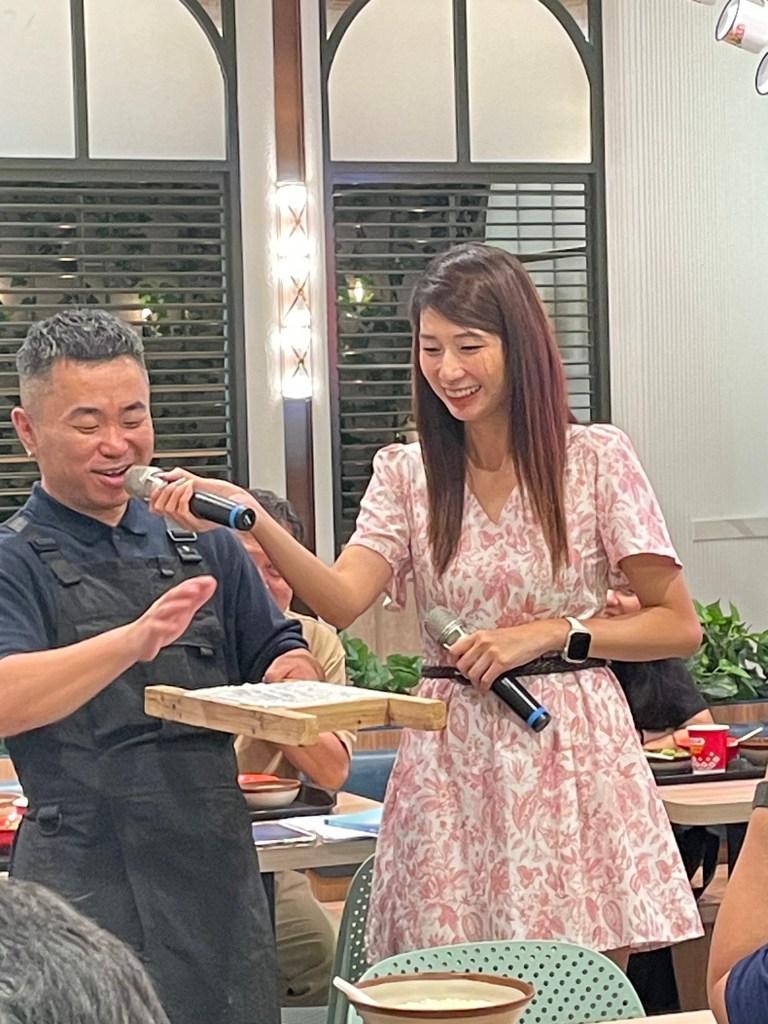
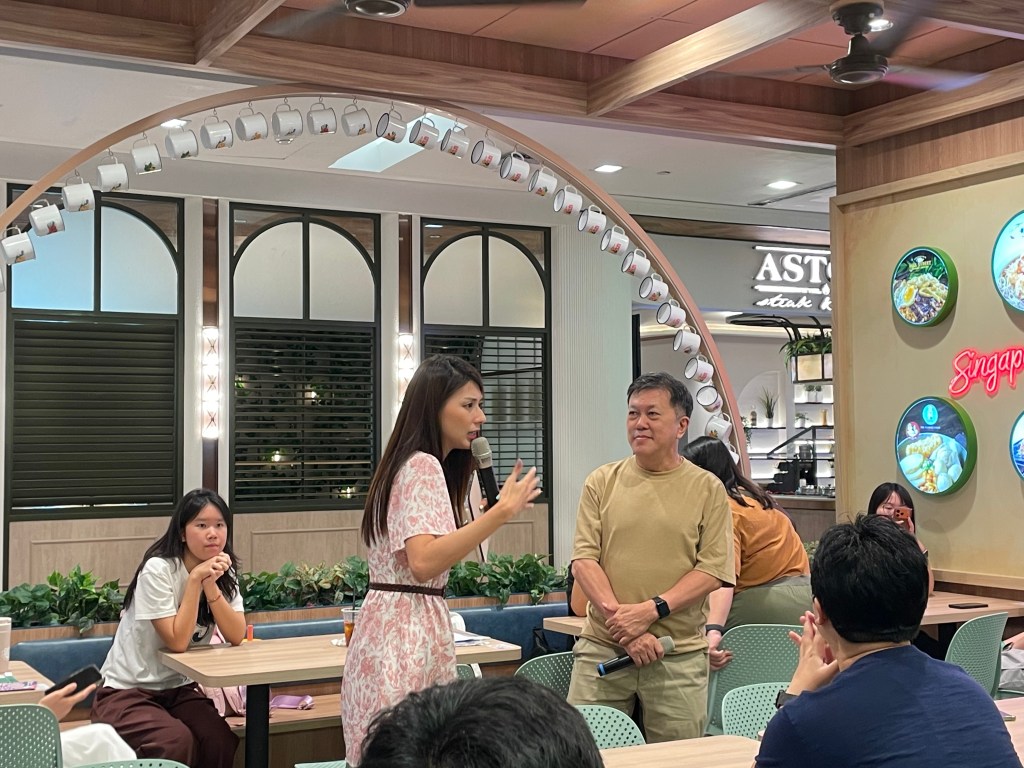
While Chef Pang went to finalise the trays of food for us, Yu Fan told us some stories about growing up as a Hakka in Singapore. Some interesting points on the diversity of the Hakka people:
- One can ask another Hakka person – What kind of Hakka person are you? (你是什么客家人?)Each Hakka person may give different answers accordingly because Hakka people spread out across China. I’m not sure about how minute the differences go – that might be something to ask the next Hakka person I meet.
- Different Hakka families grew up eating different kinds of foods. Yu Fan explained that he didn’t grow up eating Abacus Seeds, but Chef Pang shared that his grandmother often made this dish for him as a child. Even the same dish could be made differently by different families.
We ended up being able to chat with Chef Pang at the end of the talk. When our table shared that a few of us were Cantonese, he told us, you must go to Guangzhou! This did make me reflect a little more about where I came from, and how connected I was with my roots. There is work to be done!
In time, the food arrived:
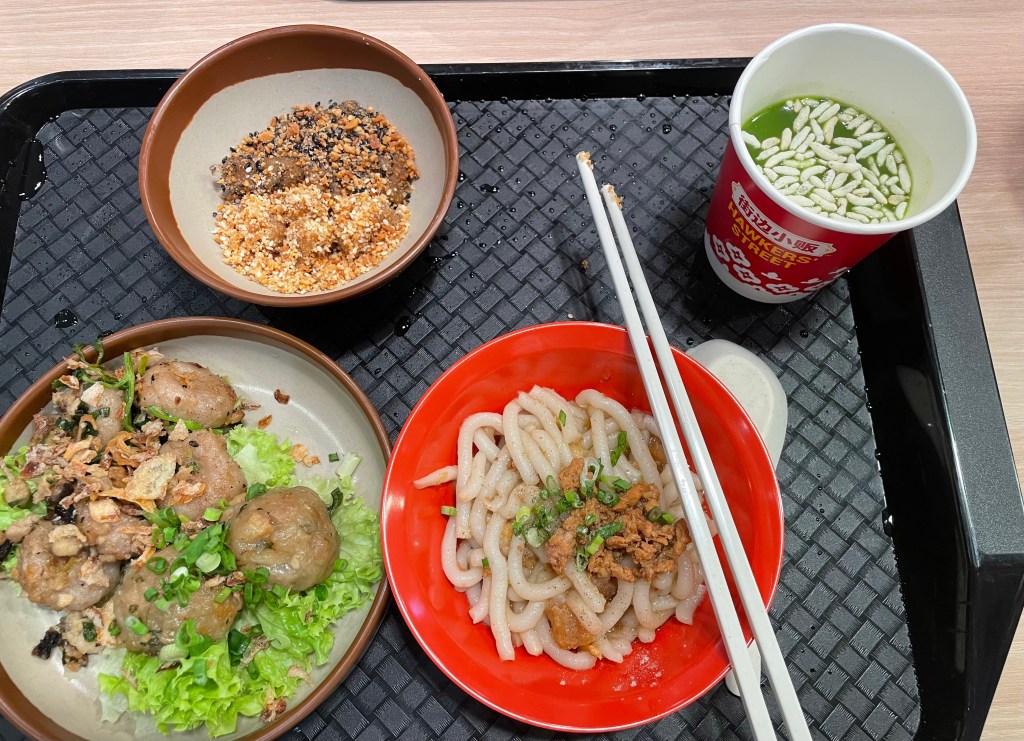
We were instructed to eat the food in the following sequence…
- Radish balls -萝卜丸(On the big plate): Unintentionally smokey (the water for steaming dried up haha). But it still tasted really good.
- Abacus seeds 算盘子(on the big plate): Chewy!
- “Rat Tail” Noodle 老鼠板 (Red bowl): Apparently, this is different from Mee Tai Mak (need to investigate this further). It came with additional chilli that was really spicy! (A Chef Pang specialty, currently not for sale… Must go to his shop to try it :D)
- Thunder Tea Rice 擂茶 (In the cup): Chef Pang explained that he adjusted the herbs used so that there is less mugwort in the tea – for “Singaporean” palates. This made me curious to taste about what Lei Cha outside of Singapore tastes like. Apparently, Chef Pang has tried some overseas and reported that it’s a lot more herbaceous, earthy…. maybe even bitter.
- Hakka “Mochi“/Ci-Ba 糍粑 (in the bowl): Ooh, this was good. There was some kinda oil (shallot? peanut?) drizzled on even though it was supposed to be a sweet dish… and it did lend a savouriness to this “dessert”.
While we ate a few dishes, Yu Fan read out a few of the poems that he had written for the event. He wrote about how taste could bring back memory and a yearning for the times that had passed… His father’s 萝卜丸, the wanton mee he used to eat as a child – not impressive to many Singaporean “foodies”, but deeply personal and dear to him as an individual.
And that is pretty interesting isn’t it? I feel that I take my mealtimes for granted today, preferring to be distracted and entertained as I eat my meal… Without knowing it, I’ve given up something precious – my ability to anchor myself to a moment in time.
Food isn’t just food – it’s history. It came from someone my age, their parents, their parent’s parents. A dish of food can tell the story of who I am… of who we are… if we can take but a moment to listen…
N
 the quarter light